Operation Northwoods
CIA SERIES: The Plan They Put in Writing

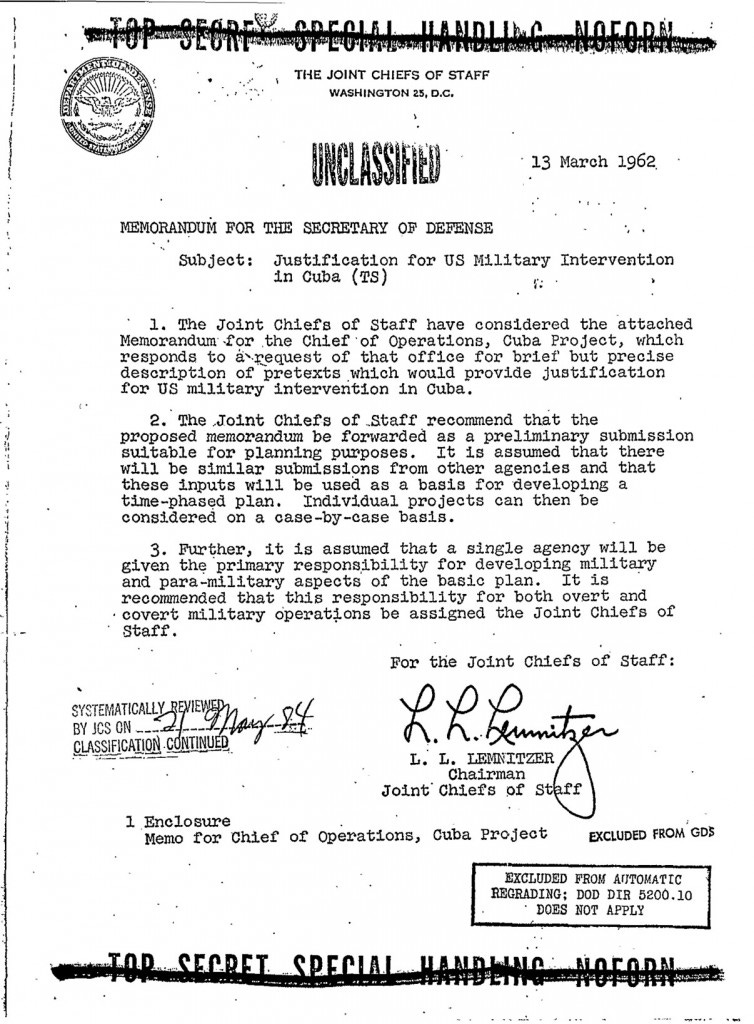
In March 1962, the top military officer in the United States handed the Secretary of Defense a written plan to fake terrorist attacks on Americans and blame Cuba for them. It proposed shooting down a civilian airliner, sinking a U.S. Navy ship, and staging a fabricated assault on the Guantanamo naval base — all to manufacture public support for invading Cuba. This isn’t a theory reconstructed from fragments. It’s a signed memo, declassified in full, sitting in the National Archives under its own name: Operation Northwoods.
What the Document Actually Proposes
On March 13, 1962, General Lyman Lemnitzer, Chairman of the Joint Chiefs of Staff, sent Defense Secretary Robert McNamara a memorandum titled “Justification for U.S. Military Intervention in Cuba.” It was a direct response to a request from Brig. Gen. Edward Lansdale, who was running the Kennedy administration’s covert Cuba program and had asked the Joint Chiefs to develop pretexts for military action.
The plan Lemnitzer sent back proposed a menu of fabricated provocations, each designed to be blamed on Cuba and used to justify American military intervention:
Staging the appearance of Cuban forces shooting down a civilian airliner — including, in one version, secretly substituting a drone aircraft for a real passenger plane, so no actual passengers would die, while the public believed they had.
Blowing up a U.S. ship in Guantanamo Bay or in Cuban waters and blaming Cuba, with the memo explicitly citing the sinking of the USS Maine in 1898 — the fabricated pretext that helped launch the Spanish-American War — as a usable model.
Staging a fake attack on the Guantanamo naval base itself, complete with manufactured evidence, under the codename Operation Bingo, explicitly described as an “excuse for use of U.S. military might to overthrow the current government of Cuba.”
A related proposal from a February 1962 memo, Operation Dirty Trick, called for manufacturing false evidence that Cuba had used “electronic interference” to sabotage astronaut John Glenn’s Mercury orbital flight, had the mission failed. Glenn’s flight succeeded before the plan was finalized.
Lemnitzer’s condition for going forward: the operations should be run by the military rather than the CIA, and there needed to be “reasonable certainty” the Soviet Union wouldn’t respond by direct military involvement.
What Kennedy Did
President Kennedy met with Lemnitzer on March 16, 1962, three days after receiving the plan, and rejected it. Documented accounts of the meeting describe Kennedy telling Lemnitzer plainly that the use of U.S. military force against Cuba was not something the administration would pursue on the pretexts described. No version of Northwoods was ever executed.
Kennedy removed Lemnitzer from his position as Chairman of the Joint Chiefs later that year. What happened next is where the story takes a massive leap from being about one rejected memo into a story about institutional accountability.
The Part That Gets Skipped
By January 1963 — the same year a follow-on Pentagon planning document proposed a related pretext scheme — Lemnitzer was appointed NATO’s Supreme Allied Commander Europe, one of the most powerful military commands in the world. He wasn’t disciplined. He wasn’t investigated. He was promoted upward and out, into a post with direct authority over U.S. and allied nuclear forces in Europe, less than a year after proposing to fake attacks on Americans to justify a war.
Needless to say, the pretext planning itself didn’t fully stop when Kennedy said no. A later Joint Chiefs policy paper proposed staging a fabricated Cuban attack on a member of the Organization of American States, calculated to trigger the two-thirds vote needed for OAS collective military action — and specifically named Jamaica and Trinidad-Tobago, British Commonwealth nations, as potential targets, on the theory that an attack on them could help pull British public opinion behind the effort. The strategic thinking behind Northwoods survived Lemnitzer’s rejection by several months, inside the same institution, after new leadership took over.
What does this prove?
What the document proves is that the U.S. government proposed to fake an attack on its own people. It proves that it is not a conspiracy theory about senior, sworn, uniformed officials, but the actual Chairman of the Joint Chiefs of Staff, formally, in writing, to the Secretary of Defense — considered faking terrorist attacks on American civilians and military personnel. Killing the plan required before getting to the execution stage, is not the same as it never having been proposed at all, by people with the authority to attempt it.
The Pattern Question
Line this up against the rest of what the 2025–2026 declassification has surfaced: an agency-owned arms company that shaped the domestic gun market from the shadows, a CIA officer who ran the group that clashed with Oswald and then spent 1978 helping Congress not find that out. Northwoods adds a different piece: proof that “fabricate a pretext and blame an adversary” wasn’t an off the wall story whispered in a back office. It was formal Pentagon planning, with a named budget, a named target list, and a signature from the single highest-ranking military officer in the country.
Kennedy stopped it. He didn’t survive the year and a half after signing the Test Ban Treaty over the same institution’s objections, in a decade defined by exactly this kind of friction between an administration and its own military and intelligence apparatus.
What the record supports is this question: when the country’s top military officer can propose faking attacks on Americans, gets told “no” and is removed from his position by the President of the United States of America, and then is promoted to one of the most powerful commands in the Western world at NATO, within the same year… what, structurally, is the actual consequence? What does this reveal about NATO? What does the disrespect and outward defiance of NATO’s actions reveal about their loyalty to the USA and the US President at the time, President Kennedy?
Facts. Logic. Common Sense.
— CmonSense
This is a part of a series called: The CIA SERIES. Subscribe and Follow CmonSense Report to follow along. Click Share below to Share this article.