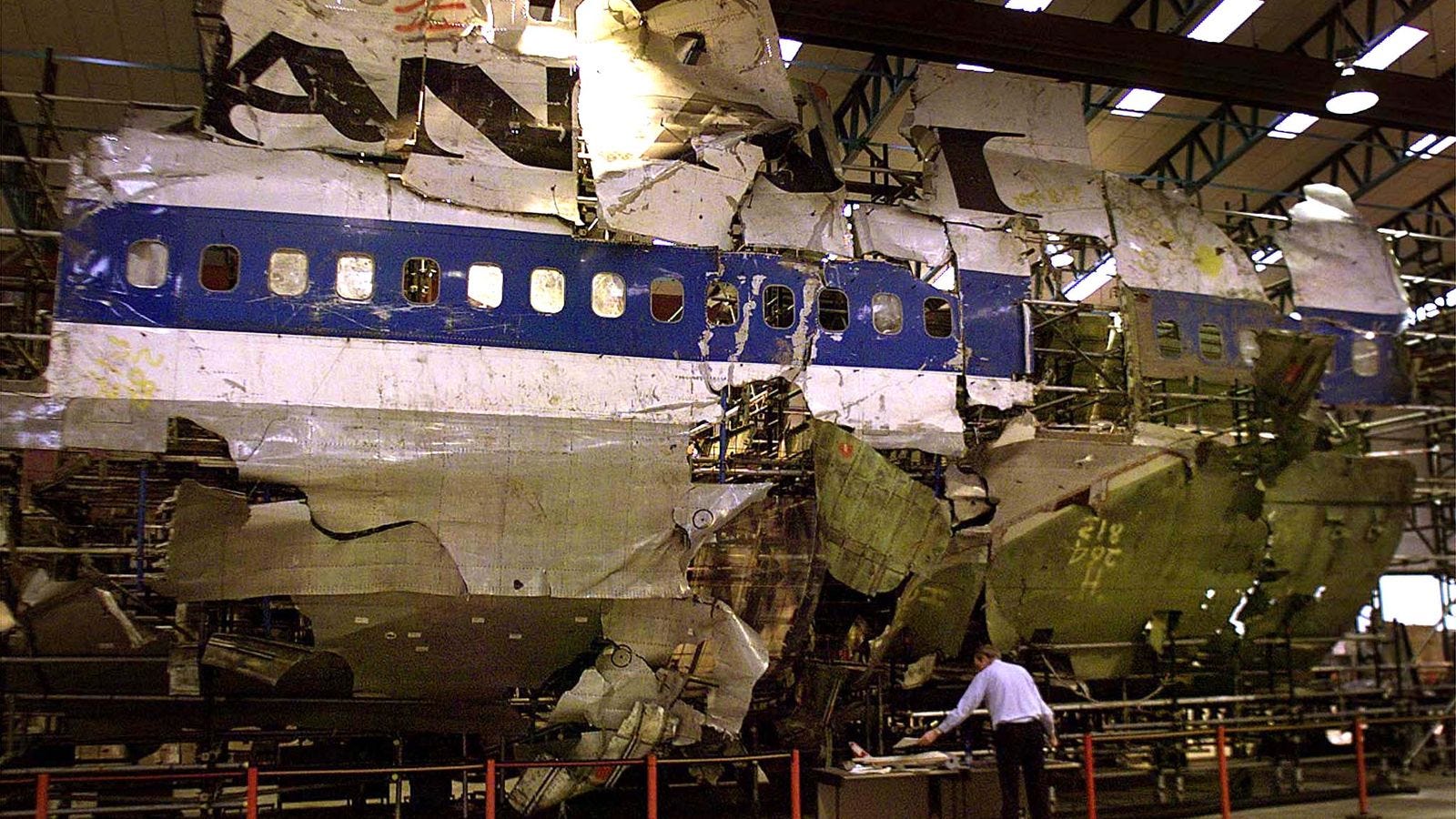
Pan Am Flight 103
The Working Theory They Walked Back

Netflix just released a six-part dramatization of the Lockerbie bombing. In seventeen days, the last living suspect finally goes on trial — thirty-eight years after 270 people died. Before you watch the show, here’s the part it almost certainly won’t tell you: the U.S. government’s own investigators had a different suspect first. And the record shows the theory changed at almost the exact moment America needed a different country’s cooperation for something else entirely.
What Happened
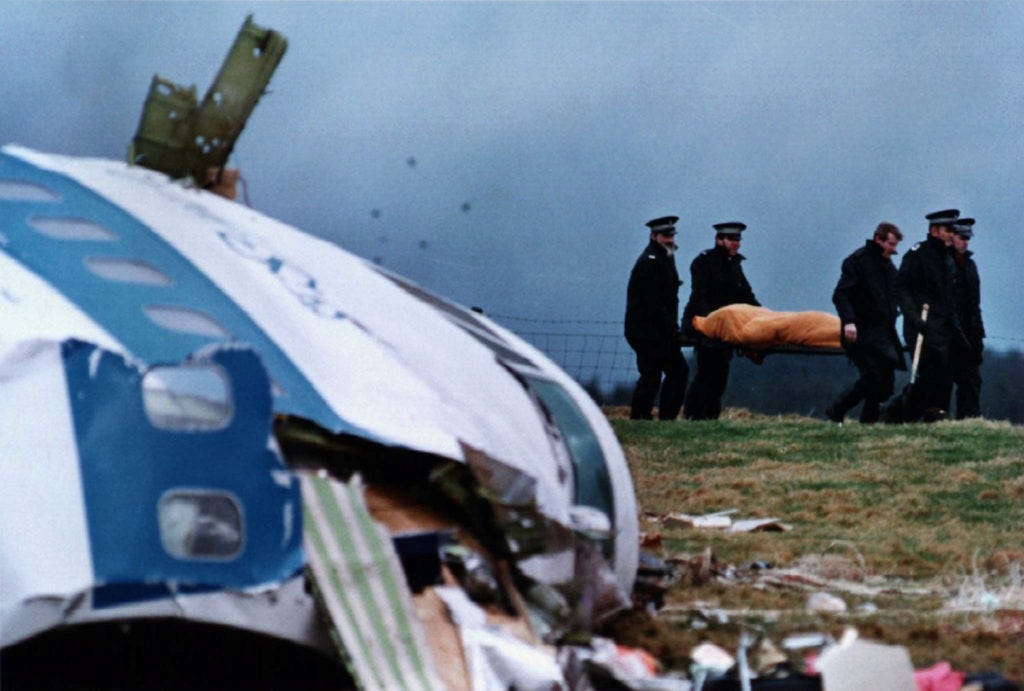
On December 21, 1988, Pan Am Flight 103 exploded over Lockerbie, Scotland, thirty-eight minutes after takeoff from London, killing all 259 people aboard and 11 more on the ground.
It remains the deadliest terrorist attack on British soil and, until September 11, 2001, the deadliest against Americans.
Two of the people killed were not ordinary passengers. Matt Gannon, a 34-year-old Arabic-speaking CIA officer, was returning from an undercover intelligence-gathering assignment in Beirut. His presence on the flight isn’t a researcher’s inference — it’s documented in the CIA’s own official internal history of the case, released through the agency’s FOIA reading room. Army Maj. Charles McKee, publicly listed as a Defense Intelligence Agency attaché, was reportedly working alongside the CIA on efforts related to American hostages held in Lebanon. McKee had switched his travel plans specifically to be on that flight.
CONFIRMED: two U.S. intelligence-connected officials died on the plane that was bombed.
What that fact means is where honest researchers, and honest journalism, has to slow down.
What Isn’t Confirmed…
For decades, a private intelligence report and several investigative journalists have argued the bombing may connect to a U.S.-tolerated drug-trafficking route through Frankfurt airport — the same airport where the bomb-laden suitcase is believed to have entered the baggage system — and that McKee’s team may have been the actual target, not collateral.
This theory is circumstantial, has never been substantiated in any court, and is disputed by the investigators who worked the case directly. CmonSense is naming it because it’s part of the documented public debate, not because the evidence supports it. It doesn’t, at least not yet, and shouldn’t be treated as settled.
The Part with an Actual Paper Trail
Here’s what’s better documented and doesn’t require believing anything about drug routes or hidden targets.
The earliest working theory among U.S. and international investigators pointed toward Iran, in retaliation for the U.S. Navy’s accidental shootdown of Iran Air Flight 655 five months earlier, which killed 290 civilians. Under that theory, the Popular Front for the Liberation of Palestine–General Command (PFLP-GC) built the device, and Syria provided the group’s operational base. This was the investigative consensus — including, reportedly, an internal CIA assessment — for roughly two years.
Then, in 1990 and 1991, the timeline shifted. The United States was assembling the international coalition for the Gulf War. Syria’s cooperation, or at minimum its neutrality, mattered to that coalition. The official case against Syria and Iran quietly receded. The prosecution moved instead toward Libya — a country with essentially no coalition value to protect at that moment. In 1991, two Libyan intelligence officers, Abdelbaset al-Megrahi and Lamin Khalifa Fhimah, were indicted.
CmonSense isn’t asserting the Libya case was fabricated to protect a wartime alliance.
Libya’s intelligence services had a documented history of state-sponsored attacks on Western targets in this era, and the physical evidence — timer fragments, clothing traced to a Maltese shop, testimony — was real evidence a court weighed. What’s simply true, and worth sitting with regardless of what you conclude from it, is the timing: the working theory changed shape in the same narrow window the United States needed a very different diplomatic posture toward the country the original theory implicated.
What the Courts Actually Found
In 2001, a Scottish court sitting in the Netherlands convicted Megrahi and acquitted Fhimah. Megrahi was sentenced to life. He served just over eight years before being released in 2009 on compassionate grounds after a terminal cancer diagnosis, returning to Libya to a public welcome that strained relations with the UK and US. He died in 2012, still maintaining his innocence.
In 2007, the Scottish Criminal Cases Review Commission — the official body responsible for reviewing potential miscarriages of justice — completed a review and found grounds to refer Megrahi’s case back for appeal, citing concerns about the safety of the conviction. That review is a matter of public record, not a fringe claim. The appeal itself was later abandoned when Megrahi accepted compassionate release instead of pursuing it. To date, he remains the only person ever convicted for 270 deaths.
What’s Happening Right Now
This is where the story stops being purely historical. Abu Agila Mohammad Mas’ud Kheir Al-Marimi — a former Libyan intelligence operative U.S. prosecutors allege built the actual bomb — was extracted from Libya in December 2022 and brought into U.S. custody. He has pleaded not guilty. His defense argues a 2012 confession, given to a Libyan investigator, was coerced.
After repeated delays tied to his health and the volume of evidence — prosecutors have produced over 356 gigabytes of data across 413,000 files — jury selection is currently scheduled to begin August 25, 2026, in the U.S. District Court for the District of Columbia. If it proceeds on schedule, it will be the first time any Lockerbie defendant faces a U.S. jury directly, thirty-eight years after the bombing.
The Pattern Question
Two intelligence officials died in an attack whose official explanation changed direction at the exact moment American diplomacy needed it to. The only person ever convicted was released after eight years and died maintaining his innocence, with the country’s own review body having already flagged doubts about his conviction. And the man U.S. prosecutors now say actually built the bomb is only now, decades later, facing a jury — while a streaming series dramatizes the investigation for an audience that, watching it today, has no idea the trial is still unresolved.
None of that proves the official record is wrong. It proves the official record took thirty-eight years to produce an actual trial for the person prosecutors say did it. When the timeline of a “settled” case runs that long, and the working theory changed shape exactly when foreign policy needed it to, the common-sense question isn’t who to believe. The question is, why does it take a full generation and an extraction operation to get a bombmaker in front of a jury for a crime the government says it always understood? Why now?
Facts. Logic. Common Sense.
— CmonSense